Feeds:
Posts
Comments

Archive for January, 2008

As I was strolling through old emails this afternoon, I came across this article that my husband sent to me…and that I forgot about…

We tend to think of memory as an etching on our brains, but this article steers us toward a much more fluid, living sense of memory.  Food for thought.

Read Full Post »

Looks like there’s another new film that tackles the dementia experience. Diminished Capacity,directed by Terry Kinney, features Matthew Broderick, Alan Alda, and Virginia Madsen. Here’s how the Sundance Catalog describes it:

“After a concussion leaves him unfocused, short on short-term memory, and demoted from the political pages to the comics, Cooper (Broderick), a Chicago newspaper editor, travels home to Missouri to visit his aging Uncle Rollie (Alda). On the verge of losing his home and exhibiting signs of senility, Rollie spends his time stubbornly refusing to pay bills, compulsively drying socks, and sitting by the lake editing ‘fish poetry’ (think typewriter keys tied to baited fishing lines). But when he shows Cooper a near-mint-condition Frank ‘Wildfire’ Schulte baseball card, the two muddled men–along with Cooper’s high school sweetheart, Charlotte (Madsen)–drive back to Chicago hoping to sell the antique card at a memorabilia convention.”

The buzz from the festival is that it’s pretty good. But the review in Variety was less impressed. Hopefully it will pick up a distributor and we’ll be able to judge for ourselves soon.

Read Full Post »

Finally! I went to see The Savages on MLK day. I saw it at Milwaukee’s “Downer” Theatre – named after the street, not the type of movies they show. The Savages isn’t an “upper” for sure. But it’s a sweet tale of a brother and sister who, at long last, wrestle with their past and start to grow up.

The Savages is not really about dementia – it’s not really about the father at all. We know very little about Lenny Savage (played by Philip Bosco), except that he clearly has a short fuse, and when it goes, he’s capable of almost anything from hitting his kids to scrawling words on the wall in his own feces. He’s confused at times, but the film makes no attempt to define his condition. He’s in a nursing home because the family has no money and because he is at risk for falls.

There are a couple of scenes that really stand out. The opening of the film is a hazy, color-saturated, slow motion dolly track through Sun City, accompanied by a simple, childlike song. Men ride golf carts here. Houses are perfectly coiffed. Older women in brilliant blue sequined body suits dance among hyper-pruned rows of shrubbery. This seems like some bizarre afterlife. But then, when we go inside the house, we find Doris staring blankly and Lenny in a power struggle with her home health aide. Later in the film, Jon (Wendy’s brother, played by Philip Seymour Hoffman) shouts that all that landscaping, all that interior decorating, is just disguising the fact that people are decaying inside. And so they are. It isn’t pretty. But when we open ourselves to it, what can we experience? What can we learn?

Wendy learns to grow up. To write her play. To get out of her bad relationship. Jon learns to finish his book and be an equal partner to his girlfriend. Lenny doesn’t grow or change. His only real moment of defining action (except the opening scrawling in feces moment), is when he turns down his hearing aid to let his children argue in private, in his presence.

The take-away from this film?

It’s really about how the act of caring for someone, even someone you don’t necessarily like, can change your life for the better.

It’s really about how we prefer not to grow up (Wendy…from Peter Pan?), to admit that we are mortal, to face what dying means in practical terms. We dance and play and distract ourselves from what might bring us tremendous growth.

Read Full Post »

Away From Her and The Savages were recognized in the Oscar nominations this week. Sarah Polley was nominated for Best Screenplay Adaptation for the script of Away From Her, and Julie Christie was nominated for Best Actress. Laura Linney was also nominated for Best Actress for her work in The Savages.

Christie seems a shoe-in, given that Oscars are rather notorious for going to people in “crip” roles. The Academy seems to love it when a gorgeous star dares to lose the veil of celebrity by taking on the role of someone with serious stigma – be it physical disabilities (My Left Foot for example), homosexuality (Brokeback Mountain or Boys Don’t Cry), or cognitive disability (Iris, or What’s Eating Gilbert Grape? or Rain Man).  Here’s a list of pretty famous films about people with disabilities…

I also happen to think Christie deserves the Oscar, as does Polley. Media coverage of the film tended to focus on the fact that Polley was still in her twenties when she wrote the script, adapted from Alice Munro’s short story, “The Bear Went Over the Mountain.” The subtext here is “why in the WORLD would a woman in her twenties write about a couple with Alzheimer’s?” Why? Because Alzheimer’s, or whatever Christie’s character had in the film, taps into epic questions like: what does it mean to commit oneself to another person for life? What is real love? Is memory the boundary of self?

The script, the direction (why wasn’t Polley nominated for direction?), and Christie’s portrayal of Fiona all combine to create a tale of late life and love that is much more than we’ve seen before of the experience of dementia. Her husband Grant (Gordon Pinsent) struggles to accept Fiona’s decision to move into a facility. But once she makes the move, she finds peace and purpose — she helps and supports (and perhaps more) a fellow resident named Aubrey.

Away From Her leaves us with questions. Did Fiona really know Grant the whole time? Did Grant betray Fiona? Did Fiona betray Grant? Does that really matter? Is the facility good or bad? Is dementia simply an awful experience? Or did Fiona and Grant succeed in finding “moments of grace?” To me, in spite of a few Hollywood/plot stylizations, the film bravely, and perfectly captures the dementia experience. Dementia is nothing if not full of questions.

Read Full Post »

Peter Whitehouse and Danny George’s new book, the Myth of Alzheimer’s is newly published by St. Martin’s Press. The title is more radical than the contents. The symptoms are certainly real. But the name Alzheimer’s assumes a discreet, identifiable disease process that can be cured–and that is where the authors beg to differ. Instead, they see the symptoms we associate with Alzheimer’s disease as an extreme form of brain aging. It’s an interesting argument – one that asks us to reconsider the labeling and the disease specific search for a cure. Instead, Whitehouse strongly argues for looking at how we can improve quality and meaning of life, and at the environmental influences on brain aging.

Whitehouse and George give us a new lens through which to see dementia. And its worth looking through.

Read Full Post »

Julie Christie won the Golden Globe (too bad we didn’t get to SEE it…) for Best Actress this year for her work playing Fiona in Sarah Polley’s Away From Her (2007). This winter movie season has brought a surge of films dealing with aging and disability. The latest in the dementia category is The Savages, written and directed by Tamara Jenkins, which features Philip Seymour Hoffman and Laura Linney as siblings who suddenly find themselves caring for their father, (Philip Bosco). This tale of a disfunctional family is more bitter than sweet, but doctors are attesting to the nail on the head quality of the depiction of dementia. I live in a second-tier release market here in Milwaukee…so I’m still waiting for it to show up at my favorite screen. More soon…

Read Full Post »

Turned it in!

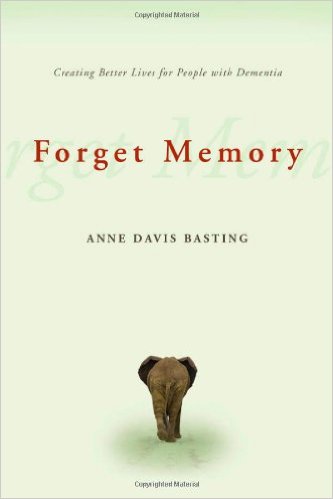
I managed to do it…I sent the book to the publisher on December 31st on schedule.  It has evolved quite a bit, and I imagine it will continue to do so with comments from the editor and reader.  But for now, it is titled Forget Memory:  How to Move Beyond Fear and Make Life Better for People with Dementia.  Don’t race to the bookstore yet…it’ll take at least 16 months to transform it from my computer files into an actual flip the pages book.

A genuine thanks to all those who read drafts, provided feedback and support, and who allowed me to interview them.

Read Full Post »

Follow

Get every new post delivered to your Inbox.

Join 32 other followers