Feeds:
Posts
Comments

Posts Tagged ‘alzheimer’s’

Margaret Gullette’s opinion piece “Our Irrational Fear of Forgetting” in the Sunday New York Times on May 21st, 2011 strikes a provocative chord.  That’s one of the many things that Margaret is exceedingly good at – striking chords.  She’s also a painstaking researcher, an eloquent writer, a keen observer of culture, and a tenacious, on-message town crier.

The piece asks a simple question.  “Is the prospect of the disease [Alzheimer's] so horrifying that it should prompt someone to consider suicide?”

It’s a hard question to answer in a short opinion piece. But her goal here isn’t to fully answer – but to drag out into the bright light of day the question that hides underneath every “senior moment,” every crossword puzzle, every advertisement for a “neurobic” computer game, every wrinkle cream, every mention of someone “still” having their mind, even every ad campaign of the Alzheimer’s Association.

“Is the prospect of the disease so horrifying that it should prompt someone to consider suicide?”

In the light of day, the question compels other questions.  Like “how much of the horror is the financial ruin most families face with the disease?” “How much of the horror is our poorly trained and inadequate care system?” “How much of the horror is fear that keeps us from embracing people with Alzheimer’s with supportive care?”  “How much of the horror can we actually change even if we don’t have a medical cure?”

I’m thankful she mentioned my work in the piece – and the excellent Making an Exit by Elinor Fuchs.  The letters to the editor the following week suggest that the reference to “forget memory, try imagination” wasn’t quite understood for its full intention.

Here is a letter I drafted in response – I doubt it’ll get printed, but I thought I’d share it here anyway.

LETTER TO NYT’s
The pain of experiencing Alzheimer’s, from the inside or the outside, cannot be covered with a band-aid of pithy phrases. Families and friends try everything to reignite the spark behind the eyes of a loved one wrestling with dementia. But when language is crumbling, “remember when?” and “remember me?” cannot make a person whole again. In fact, trying to rebuild memory can reinforce the pain of loss. When I say “Forget memory, try imagination” is not a pithy band-aid over an unhealable hurt.  It is a guidepost, drawing family and friends to find each other again by simply removing the expectation to “remember.”  The open, poetic language of improvisational storytelling, movement, music, or visual art can reconnect us in deeply meaningful ways.  15 years of research, practice, and the glowing faces of people with dementia who rediscover their ability to make meaning again are powerful proof that creativity and imagination are largely untapped reserves of strength when dementia strikes.

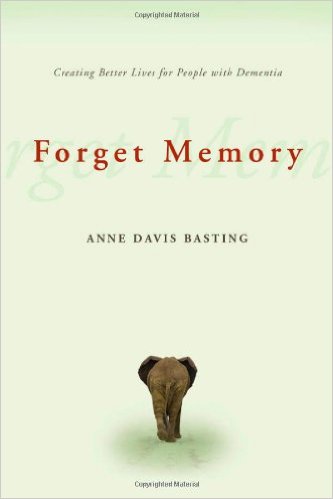
Anne Basting is the author of Forget Memory: Creating better lives for people with dementia, 2009, and founder of the TimeSlips creative storytelling project for people with dementia.

Read Full Post »

In July, I accompanied museum educators from 5 Wisconsin museums to NYC to learn about developing programs for families with dementia.  The John Michael Kohler Art Center (Sheboygan); the Museum of Wisconsin Art (West Bend); the Racine Art Museum (Racine…); the Milwaukee Public Museum; and the Leigh Yawkey Woodson Museum (Wausau) were all awarded planning grants from the Helen Bader Foundation to support the development of such programs.

Over the course of two days, we visited MOMA, The Museum of Folk Art, and theMetropolitan Museum of Art to learn and observe (I actually presented a session on arts/creative engagement programs across the country).

The buzz was tremendous.  The museum educators (and one community partner) had some amazing ideas of how to work together in coalition – to share trainings, promotion, etc.  to let families know about all their programs.  This is truly a new wave…

Read Full Post »

It’s really amazing what MOMA and other museums are doing now – offering educational programs in art to people with dementia and their families.  But a NYT’s article today explores an even more radical step – bringing the museum to the nursing home.  At the Hebrew Home in Riverdale, they have opened a Judaica museum.  Residents can tour on a daily basis.  Outside guests have a chance to see not just the images and objects, but living examples of American Jewish history – the residents.

Read Full Post »

Theater inside Nursing Homes

I’m learning of more programs that bring interactive theatre to people with dementia.  Here’s Ladder to the Moon, working in London.  And Theater Veder in the Netherlands.  I’m embarking on my own project in this area, working with Sojourn Theater. Stay tuned!

Read Full Post »

A really lovely story on NPR’s All Things Considered today about a painter in NYC (Ken Rab) in his 50s and experiencing early on-set Alzheimer’s.  His partner Stuart Post has created a supportive, loving, challenging world for Ken – one in which his creativity can flourish.  It’s a quite a contrast to the HBO stories…positive and engaging, realistic, but not frightening.

Read Full Post »

A really fascinating article today in the NYT’s about the “super-memory” study of the 1 in 200 people who make it to 90 with their cognition largely in tact.  And the 1 in 600 who make it to 95 without a diagnosis of dementia.

The study of these folks by USC and UC Irivine is trying to tease out the answer to the condundrum “Are they active because they are sharp or are they sharp because they are active?”

The study is finding that exercise and diet aren’t as big of an indicator as some studies are suggesting – but that mental challenge/exericise and social engagement are.

“So far, scientists here have found little evidence that diet or exercise affects the risk of dementia in people over 90. But some researchers argue that mental engagement — doing crossword puzzles, reading books — may delay the arrival of symptoms. And social connections, including interaction with friends, may be very important, some suspect. In isolation, a healthy human mind can go blank and quickly become disoriented, psychologists have found.”

But the most fascinating thing about the article is the way the group of card-playing “super-memory” 90+ year olds talk about what happens when they detect one of them is slipping.  They are kicked out of the group.  And, as they observe, their isolated friends quickly decline.

My question is WHY?  Isn’t there something else they could do that could maintain their friendships?  Like maybe…ART?  DANCE?  MUSIC? POETRY?  WRITING?  Cards are fantastic.  But you can also challenge yourself mentally in a non-competitive way that allows for friends to maintain social connections rather than set them off on the ice-flow.

Read Full Post »

I didn’t hate it!  Nick Doob is a phenomenal cameraman – and he and Shari Cookson directed and produced this episode.  I’m a little baised on that front, he has worked with my husband on a couple of films as well…so I admit that warmed me up for this episode.

Here are my thoughts as I was watching…

The opening segment is about a woman who is really pretty early in her memory loss.  She is a hoot, as my mother would say.  She gets together with women friends in a singing group and they serenade a local nursing home.  The segment almost feels like a commercial for Aricept… “that’s where I got the idea to take pills for my memory” she says…and then later, we see her getting her prescription and swallowing the pills.   She seems pretty fine about things.  At one point she tells a friend “sometimes I can’t remember your name.”  “That’s okay,” her friend says. “I’ll tell you my name if you forget.”   THAT to me is HOPE.  More than the pill she takes in this segment, which will help for a couple months maybe.  But her friends will help her through to the end.

Another segment features a self proclaimed computer genuis, who isn’t anymore.  We see him in a therapy session (now THAT is opening yourself to a documentary!) in which he tells his doctor in so many words that he plans to kill himself as soon as he feels that he is “no longer really himself.”  It’s important to show this – as this really is what you hear people saying.  But it’s also important to show that this isn’t the only option.  And that that is painful for the family too.

There’s a segment on a woman living on a farm with her daughter.  She speaks only in a kind of sing-song sound and wanders…but we gradually realize that she was and remains an artist.  Her daughter photographs little “vignettes” that her mother makes and leaves around the farm for her to find.  And they are wonderous.  There is clearly emotional pain here – the daughter is so hard on herself when she shows her mother a stone and her mother puts it in her mouth.  But there is also mystery and connection on a deep level.  The sorrow here is when the daughter says she never had children…and you wonder who will be as tender of a caregiver to her as she is to her mother…

There’s an amazing segment about a man who happily whistles and sings and walks with a tender and loving companion…whom we learn is not his wife.  One of the most touching scenes I’ve seen on film about dementia is in this segment.  The camera follows the couple as they walk into an empty bedroom and lay down on the bed together.  The hold each other.  She strokes his chest as though they were newly weds.

His wife and daughter are rather astounding – they walk in and warmly greet the two of them and explain to her that he’ll be back soon.  They take him to a concert of his singing group – and in the car he asks over and over again where they are going.  When the choral leader introduces him as leading a song…we really don’t think it’s possible.  And then the miracle of music and memory – he sings clearly, confidently, beautifully – the entire song.   A standing ovation erupts.  This is community. This is the arts bringing people with dementia into community.  Wow.  And then in the car – he has no idea again.

There is a haunting segment about a woman experiencing hallucinations – which can be part of the Alzheimer’s experience.   There is a lovely moment in the beauty salon when a fellow resident tries to comfort her clearly paralyzing anxiety.   But one of the most difficult moments in the show is when her son struggles with his mother not remembering him.  It shouts out for the need to help families move beyond memory – just be there with her, talk to her in the now, try to comfort her anxiety.  It’s hard…but it is possible.

There is a segment on Cliff, magician and host of a beloved and long-running children’s television show.  His wife is elegant and loving – and makes you wonder why some people get this and not others?  Truly, why?  We watch him edge toward hospice, and then are privy to his final moment.  It is a true gift of this loving family to share this moment with others who will soon face it.  May they be fortunate enough to experience the quality of hospice care that Cliff did…

And after this powerful moment in hospice, we end where we began, with the woman taking her memory pills…leaving us anticipating the potential trajectories of her journey into Alzheimer’s.

The messages of this episode were more complex than I anticipated…they showed the incredible power of the arts to help people communicate with people with Alzheimer’s and dementia – and the incredible NEED for these programs.  MORE MORE MORE!  Right now, companionship, community and creative expression are doing much more than that pill.

Read Full Post »

I’ll watch the HBO series with an open heart and mind – I swear I will.

But the reviews are certainly daunting.  The whole point of Forget Memory is that there is MORE to Alzheimer’s than tragedy.  That there is HOPE in science, but there is also HOPE in human beings – in our ability to learn to be in the company of people with dementia and to find meaning in that experience.  In one section of the book, I talk about the types of stories that are told about dementia in popular culture.  By far the most dominant one is TRAGEDY with science as HERO.  And from Alessandra Stanley’s review in the NYT’s, it sounds as though the HBO project not only falls into this category, but takes it to a new extreme.

Stanley points out that in the segment on developments in research, medical researchers enthusiastically suggest that they are very near a cure. One in particular calls it the most exciting area in medical research today.  But Stanley writes:

“Neither he nor the filmmakers deliver many caveats about the long, bumpy road from clinical trial to prescription pad. At times the collective exuberance is so persuasive that viewers have to remind themselves that there is as yet no way to prevent the disease or even slow its progress.

And that’s a problem. It suggests that “The Alzheimer’s Project” comes with an implicit agenda of morale boosting — and fund-raising — that could compromise a balanced understanding of this frightening and complicated disease.”

It’s a little heartbreaking.  In Forget Memory, I profile over 10 programs that are raising the quality of life of people with dementia and reducing stigma and fear – over 10 programs where HOPE is in humanity – our ability to reach each other, care for, honor, and learn from/with even those late in the disease.   But what we’ll hear in the Alzheimer’s Project looks like it loss of self, suicide as the only option, nobility of caregivers in a losing battle, and the heroism of science.   At least, after working so hard on a book for so long, its message will still be relevant when it comes out at the end of the month…

It’s fantastic to get the country talking about Alzheimer’s.  It is.  More people need to know about the services available, and more people need to ask how they can help.  But a message so powerfully frightening about the lived experience and so powerfully positive about science risks deepening the pit of despair when cure continues to be elusive rather than X’ing out hopelessness.

Also see the NYT’s background article on the Alzheimer’s Project.

Read Full Post »

Activities.   The word makes me think of things people don’t really want to do, but are coaxed into.  The word seems a cold categorization of things that keep us busy and not thinking about other things…things that we might not have anymore.

I’m neck deep in thinking about “activities” now as I prepare for the Center on  Age & Community’s (which I direct) Next Step Think Tank.

Artist David Greenberger and musician Paul Cebar

Artist David Greenberger and musician Paul Cebar

This year, we’re gathering leaders in the arts, education, aging services, and media and technology, as well as students and family caregivers to think about “How can we radically transform activities in long term care?”

Over the two days, we aim to 1) describe what we’d like activities to be like – for those living in individual homes or in group settings; 2) enchant or enliven a dozen or more “recommended” activities according to our own description of what activities should be like; 3) identify why activities aren’t working or aren’t accessible now; 4) imagine ways to help them work.

And dare we imagine a better word than “Activity?”

Our first question for the day on May the 14th will be…”what is the meaning of meaningful?”
We commonly hear that activities should be “meaningful.”  But just what does that mean?

The opening event for the Think Tank is Cherry Picking Apple Blossom Time, David Greenberger and the Paul Cebar Stage Ensemble’s performance of songs inspired by conversations with people with memory loss at the gorgeous Pabst Theater in Milwaukee.  I’m struck by the timing – such a powerful, empowering message for people with dementia coming the night after the HBO Alzheimer’s Project.

Imagine an “activity” in a nursing home being collaborating with an artist to create a collage of songs that will be made into a cd and then performed in your community at the most beautiful venue in town?

Read Full Post »

And now we learn, in the 2 weeks before the release of HBO’s new Alzheimer’s Project on May 10th, that Maria Shriver is an executive producer.  She’s making the press rounds to promote the project now – I’ve seen her last Sunday’s NYT’s Magazine and this article and interview in AARP’s mag.

I am reminded of something Naomi Boak (Exec Producer of the documentary The Forgetting) told me once.  In so many words, she said that the point of film/tv is to have a big message that gets/holds attention and leads people to more nuanced ideas on websites, articles, and books.  But is it worth it?  Do people ultimately get the more nuanced information?  In response to the AARP interviewer’s question “Why should more people be concerned about Alzheimer’s”, Shriver talks of the increasing numbers of people with early on-set, and then says “and with Alzheimer’s you are out of commission on every level. You need 24-hour-a-day care, but we don’t have enough caretakers and facilities.”

Eventually yes.  But the more nuanced story would explain that people can live 15 years with Alzheimer’s and other types of dementia.  I worry, as I do throughout Forget Memory, that such alarming statements usher those trying to live with the disease (and I can imagine Peter Whitehouse cringing at my use of that term!) right back into stigma, social isolation, and shame.

David Shenk and I have a friendly disagreement on this – as I do with many scientist/researchers.  Perhaps they are right and the race for the cure and the tragic story need to lead popular consciousness in order to get any attention for Alzheimer’s in our landscape of multi-tasking where ageism and other fears keep most people’s heads firmly planted in the sand.  Perhaps those of us in the arts and person-centered care movements just need to get a lot louder.

Read Full Post »

Older Posts »

Follow

Get every new post delivered to your Inbox.

Join 31 other followers