Feeds:
Posts
Comments

Archive for the ‘books’ Category

It’s such an exciting time…so many new images of dementia are coming out.  Here’s one – I read about it on the Speaking of Faith website.  Phillip Toledano’s Days with My Father is a going to be coming out as a book, but for now is a web-based photo essay about his father’s memory loss and confusion.  It’s loving, sad, funny – poignantly capturing the whole range of the experience.

Read Full Post »

I remember sitting in a conference hotel (which hotel was that? which city?) and meeting (oh! I remember, it was Atlanta…) John Zeisel for the first time.  Meeting John is not something you forget (the city, now that’s a different matter).  John’s engine revvs at an unnaturally high level and doesn’t seem to stop.  At our first meeting in Atlanta, we both talked about writing books that had been forming in us for more than a decade and that seemed to be coming out of us in final draft form.  This was both a little scarey and exhilarating at the same time.

John and I share a world view on dementia and Alzheimer’s.  John is the president and co-founder of Hearthstone Alzheimer’s Care, Ltd.  His research into the impact of environmental design on the experience of dementia led him to advocate for a new way to think of “treatment” for Alzheimer’s.  We tend to think of treatment in the form of pills.  But Zeisel pushes us to consider the environment as part of the treatment plan.  How is the space designed?  How are people with dementia encouraged to use the space?  What kinds of programs/events enliven the space?

Zeisel also founded and co-directs Artists for Alzheimer’s, which seeks to bring the arts and artists into the lives of people with dementia.  Zeisel’s book, I’m Still Here: A breakthrough approach to understanding someone living with Alzheimer’s, has a section that explore various forms of the arts, including the TimeSlips project.  And in Forget Memory, I have a section that talks about Artists for Alzheimer’s.

I’m Still Here is clearly and accessibly written, and exudes Zeisel’s passion for changing the way we think about and treat people with dementia.  It works as a practical guide for families, for friends, and mainly I think for the people at the steering wheel of care systems and facilities, to better understand and care for people with dementia.

Some three years after meeting him for the first time, our books are meeting the marketplace at the same time, and I hope, acting as a one-two punch to jar the field into seeing people with dementia and the system in which we care for them, a little differently.

Im Still Here

I'm Still Here

Read Full Post »

It’s Ready!

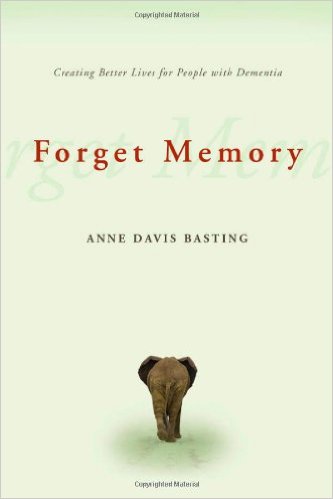
At the GSA (Gerontological Society of America) conference over the last weekend I visited the Johns Hopkins University Press booth and lo and behold!  Forget Memory is listed in the spring 09 catalog!  I shifted the “About” column to feature the blurb/reviews and the ordering info.  It’s been a long time in coming – so it’s really gratifying to see the flyers and the catalog…

Thanks again to all those who helped me shape this book.  I interviewed tons of folks and profiled some incredible programs.  I’m so excited to start spreading the word about just how much great work is being done out there in the shifting field of dementia care.

Read Full Post »

Oliver Sacks calls Alix Kates Shulman’s latest book “An extraordinary and important book.”  I agree.  To Love What Is is Shulman’s (author of Memoirs of an Ex-Prom Queen) account of a life-altering night when her beloved husband fell from their sleeping loft in their remote cabin in Maine.  Many harrowing encounters with the health care system later…Shulman and her husband Scott find themselves in a new terrain of deep love, dramatically altered abilities, and of changed horizons of hope.

Shulman’s tale is elegantly and thoughfully told.   A moment that stays with me is when she tells of her shock at a friend’s response to her situation.  The minute they close the apartment door to embark on a walk together, her friend burst out with shock at Scott’s condition and at Shulman’s courage to keep him at home.   Shulman honestly didn’t consider it a sacrifice.  Why did her friend? Should she?  They are deep and probing questions…explored by a deeply talented writer.

Read Full Post »

Jesse Ballenger has a fantastic article in Newsday today, which contextualizes the lived cultural experience of people with Alzheimer’s, and inviting more activism to insist on creating a valued place in culture for people with dementia.  Ballenger is the author of the incredibly detailed and rich history of senility in modern America, Self, Senility, and Alzheimer’s Disease in Modern America.

Read Full Post »

Looks like PBS will be rebroadcasting The Forgetting this summer.

I have mixed feelings.

On the one hand, the film certainly has been a powerful tool for raising awareness. The local feeds afterward, which feature more nuanced discussions of the experience of dementia, are very informative and moving.

But the film itself is pure tragic narrative. I almost felt like I was suffocating while I watched it (several times) as research for the book. What is missing from The Forgetting (television version) is any sort of sense of the resiliency of people with dementia. There is no meaning in their lives. There is no humor. No joy. This film chooses to tell the story of the tragedy of dementia and the exciting scientific race for answers.

The book (by David Shenk) is a skillful and inviting weaving of the complexities of Alzheimer’s. The website is equally complex and inviting. But the film scares me. And I fear it scares others more than it inspires them to respect and engage people with dementia – and in so doing, to be part of the social cure.

The Forgetting Rebroadcast and Panel Discussion on PBS

The critically acclaimed documentary, The Forgetting: A portrait of Alzheimer’s, will be rebroadcast this summer on PBS stations nationwide. Immediately after the 90-minute documentary, stations will air a 30-minute panel discussion about the disease moderated by David Hyde Pierce featuring a number of researchers with whom the Alzheimer’s Association works closely. The Association is working with the producers of the program to provide Chapters with tools you can use if you would like to leverage this opportunity to generate awareness of the disease and the Association. This will likely be ready the week of June 23. The program will air in most markets on Sunday, August 3 at 9PM ET. Check your local listings for exact airing times and dates in your market.

Read Full Post »

When I was first pitching Forget Memory to agents, a very successful agent whom I admire a great deal told me that it was a great idea, but that unfortunately, in her experience, “dementia doesn’t sell.”  I just got word today that Lisa Genova’s book Still Alice, which she initially self-published, has been picked up by Simon and Schuster for a hefty six figures.  It’ll be out in early 09.

There are three books out there right now on midlife memory loss (Carved in Sand, Can’t Remember What I Forgot, and Where Did I Leave My Glasses?) and an elegantly written fictional account of early on-set AD, The Story of Forgetting.  I’m sure the film rights for The Story of Forgetting and Still Alice can’t be far behind, if they haven’t already been snapped up.

Dementia is starting to sell.   Perhaps this means that we are starting to break the threshold of being able to talk about dementia…and to live with it as human beings rather than be considered vegetables.

Read Full Post »

As the population ages, the marker of “normal” in memory loss will continue to shift. There are several books out now that address the worry over memory loss in all its manifestations – from seemingly benign to the significant losses in the dementia experience. The latest entry is coming out this month from Harmony Books, a division of Random House. Sue Halpern’s Can’t Remember What I Forgot: The Good News from the Frontlines of Memory Research is a personal journey through memory research. I’ll write more after I have a chance to read it, but for now, check out reviews and ordering info here.

Read Full Post »

I had a conversation yesterday with a friend who had just talked with some of the fascinating folks doing person-centered dementia care in Australia.  There is lots of work happening internationally that fell out of the scope of Forget Memory (which is United States-centric), and I start this series of entries to draw people’s attention to some of it.

First I’ll point to my collaborator on the Arts and Dementia Care Resource Guide, the incredibly gentle-spirited John Killick and his partner Kate Allen, who have a website/consulting group called Dementia Positive. John was a teacher for 30 years.  In 1989 he began a journey that has led him deep into community-based arts in communities of need – prisons, and now, predominantly, health care settings for older adults.  He began by writing poetry with people with dementia.  His adventure in writing coincided with the groundbreaking work of Tom Kitwood in England, and Kitwood’s ideas are manifest in John’s elegant, respectful fostering and sharing of voices of people with dementia.  Kate is a clinical psychologist with deep community-based experience, whose specialty is working in communication with people with dementia.

The site includes publications (books on poetry, communication, and  the arts in general), Allen and Killick’s bios, and bios of fellow travelers.

John and I had the funny experience of collaborating on the Arts and Dementia Care Resource Guide strictly via email.  We finally met at the Society for Arts in Dementia Care’s conference on Creative Expression, Communication, and Dementia in Vancouver in May of 2006.  To sit and tumble into discussions of his work over the pond as we ate box lunches with a view of mountains and water was the highlight of the conference for me.

Read Full Post »

I picked up the book at Kramer’s (another favorite independent bookstore) in D.C. when I was there for the American Society on Aging in March. I started reading in a cramped Thai restaurant (sipping my favorite soup) and finished on the plane to Florida a week later. But the characters are so inviting (quirky as they are) and the story so playful (even if the topic is edged with sorrow), that it felt like I read it in one sitting. I was immersed in Block’s world.

There are autobiographies by people with early-onset, and many, many memoirs by caregivers. Some among these are very important – they let us know the hearts and minds of people going through the disease, and they chart out the experience of it in detail much greater than the medical diagnosis (which was really all we had for a long time).

Fiction, especially good fiction, about this experience can do something a little different – which is transform the experience of dementia/Alzheimer’s.

In the Story of Forgetting, which was featured on Weekend Edition on NPR over the weekend, Block does this beautifully. He wrestles with the core questions. Why would parents who know there is a chance of giving this to a child, have children? Why does this exist? Does it have any meaning at all? I can’t say that there are clear cut answers to these questions in the book – but there is a consistent, underlying dignity in all the characters, from the women who became carriers of the disease (in Block’s telling), to the ancient man with humpback who struggles to stay in his house so that it might be there for his wandering daughter to return to, to the young man who inherits not just the likelihood of disease, but the 1,000 pound, existential questions that come with his mother’s diagnosis and his father’s depression. There is love, goodness, and even whimsy in the darkest moments in Block’s world(s) – and that more than answered the Why for me.

My new motto for the field is that we need to raise awareness without raising stigma. And this tender rendering does just that. It is PACKED with science and realistic portrayals of the experience. And hope for meaningful connection in the moment.

I’m told by Don Moyer of Still Alice, another fictionalized portrait of early on-set – and I’ve ordered it and look forward to sharing it here with you soon.

Read Full Post »

Older Posts »

Follow

Get every new post delivered to your Inbox.

Join 32 other followers